Inland Tides. Curated by Grace Herbert. RISING. Melbourne 2021
materials: frozen inland lake water, frozen civic water, Harcourt granite, neon light, hydrophones, speakers
Photo credits: Andrew Curtis
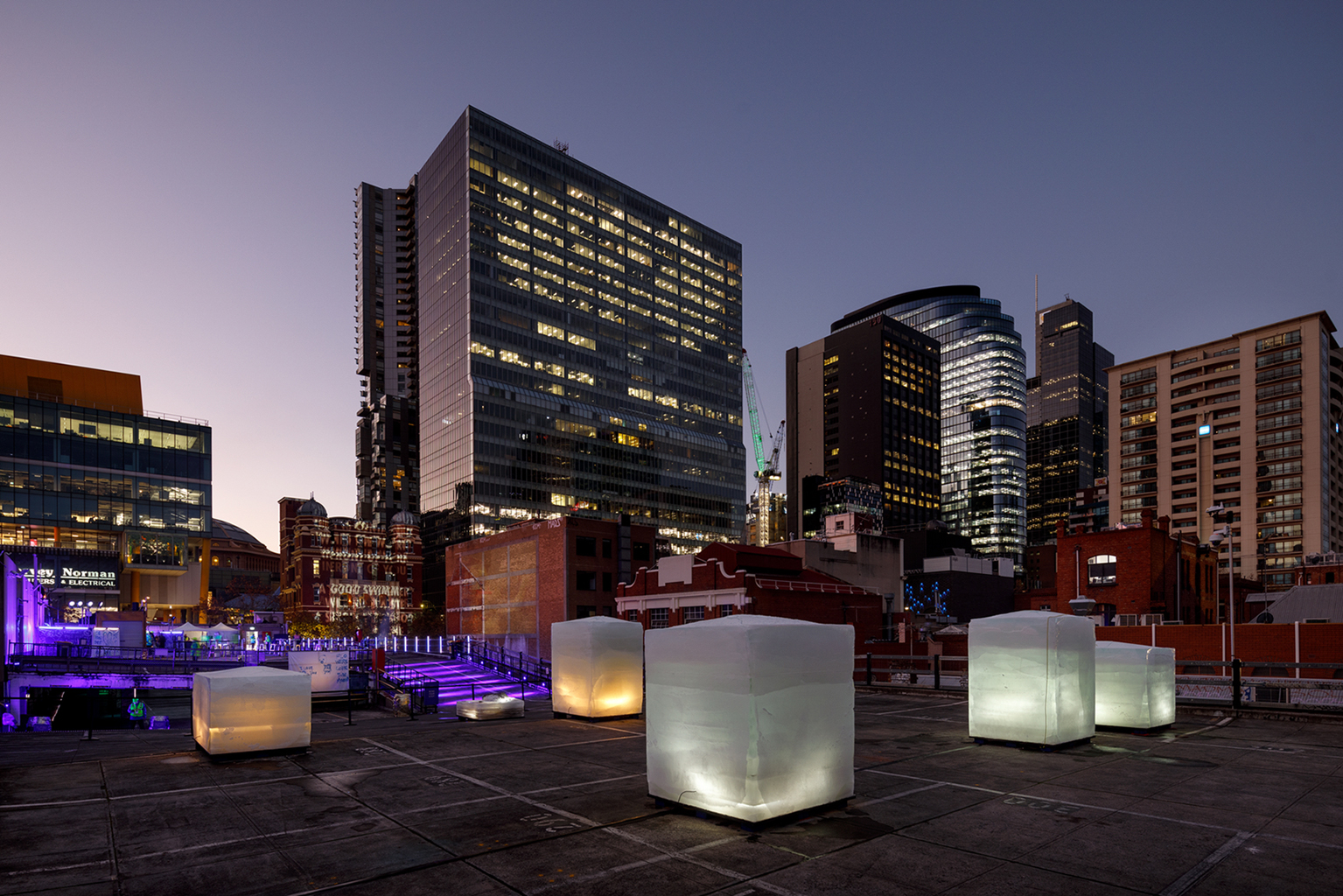
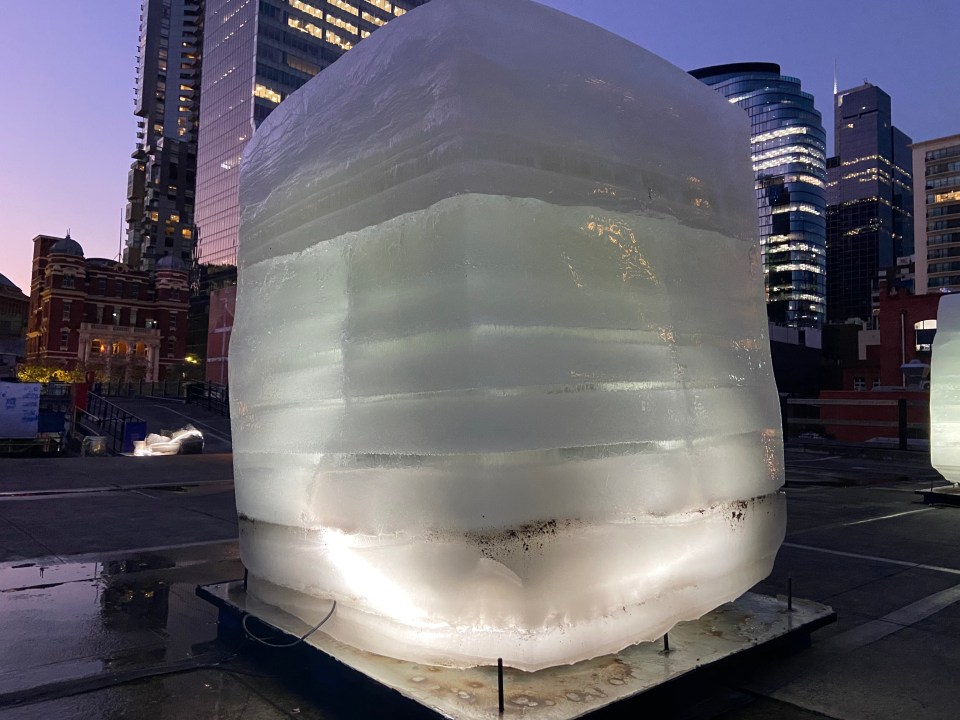
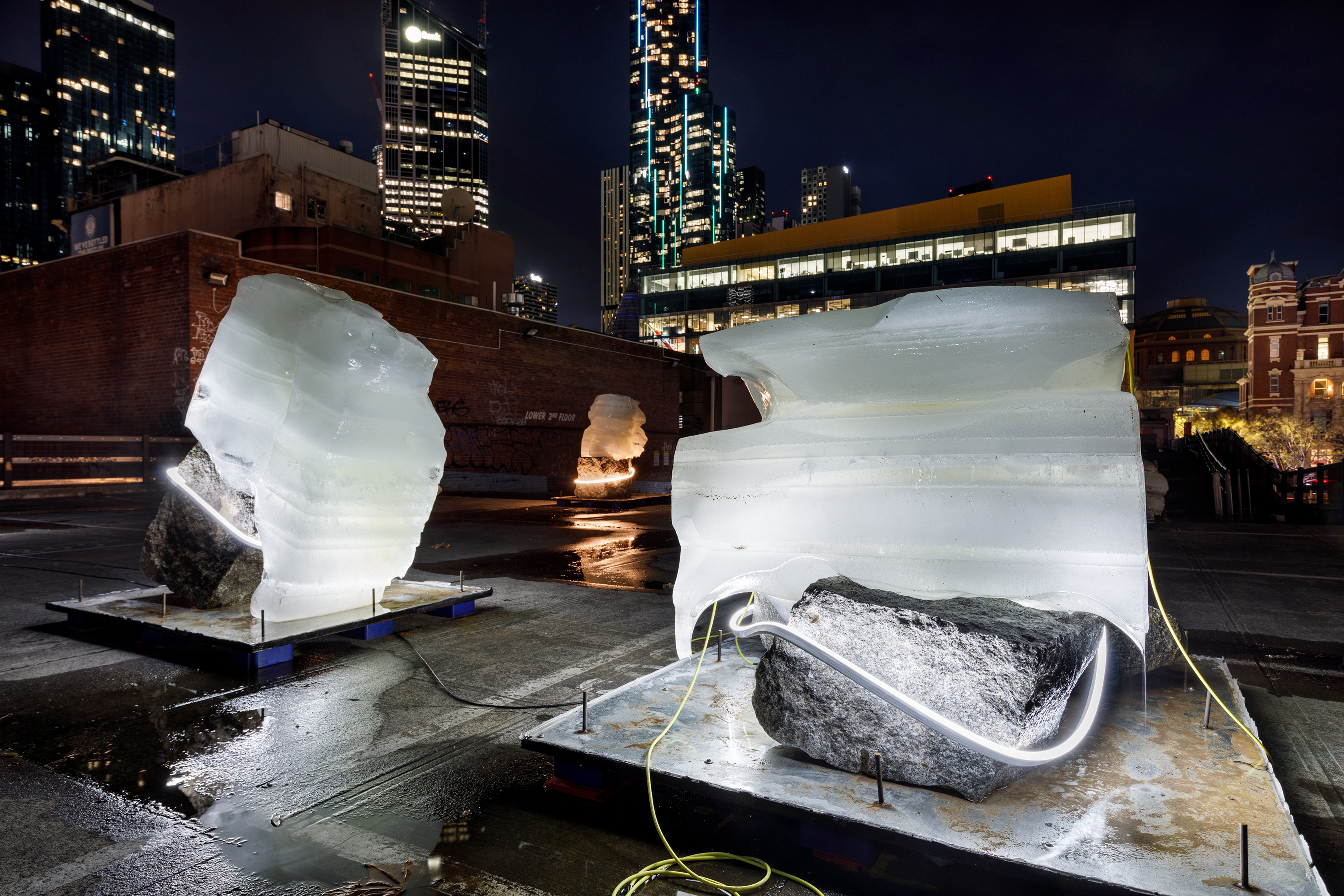
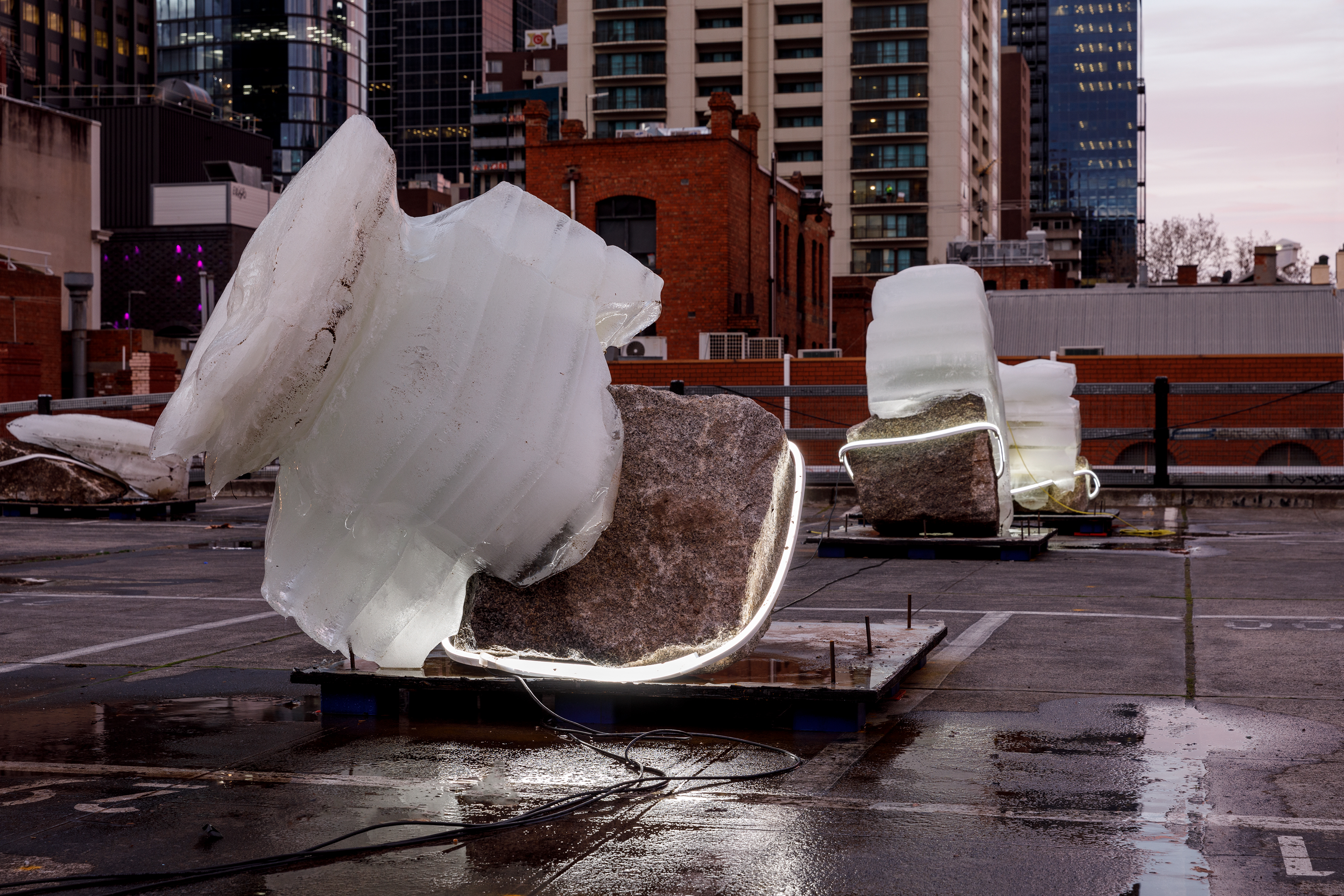
Over the RISING festival, large blocks of ice were ‘parked’ on the top floor of the Golden Square Car Park in the centre of Melbourne’s central business district. The ice blocks were composed of frozen layers of water, sourced from both the Melbourne water supply via the tap, and inland lakes in Victoria. Comprising varying degrees of translucency, mineral content and suspended sediment, as the layers melted, a mingling of lacustrine and civic water leached over the carpark and out into the city.
Frozen into the ice blocks, hydrophones captured the slowly cracking ice. The live sound was amplified through speakers installed in a nearby stairwell, enabling the transitioning ice forms to be encountered through different senses, at different times and in different spaces.
Embedded within each ice block, boulders of Harcourt granite lay latent in the frozen mass. Harcourt granite, recognised as a valuable building material for the construction of the city of Melbourne, was quarried from Mount Alexander in the mid 1800’s, and features in many of Melbourne’s formative civic buildings, including the original Stock Exchange and Parliament House. The boulders within the ice were the wastage from building blocks extracted from the quarry at this time, with many evidencing the chisel scars produced during the splitting process.
During the late Devonian period, a vast granite intrusion extended across Victoria and Tasmania (then a connected land mass), part of which resulted in the Harcourt granite batholith. The approximate time of the granite’s formation, 358,900 000 million years ago, was translated as a sequence of slowly pulsing light wrapped around each frozen boulder, with the duration of each pulse reflecting the average length of a human breath. The light algorithm synthesised the time of the rock’s creation with the rhythm of human breathing, a kind of mingling of geologic and human vital registers.
By This Lake suggested implicit forces at play which are simultaneously still and mercurial, deep and diminishing. Inseparable and contradictory opposites, we are in the thrall of vanishing and enduring forms.
Acknowledgements:
In Dja Dja Wurrung language Mount Alexander is known as Lanjanuc, named by the Jaara people. The artist acknowledges and pays respect to the Jaara as the ancestral and enduring custodians of Country from which the boulders were extracted at the time of colonisation.
The artist gratefully acknowledges the generous support from the following people and organisations:
Jon Smeathers for sound design; Steve Outram + Moonman construction; Jason James for lighting design; Stuart Houghton construction; Rocks Plus for the loan of the granite boulders.
 lucybleach.com.au